Journal of Pharmaceutical Research
DOI: 10.18579/jopcr/v25.i4.155
Year: 2026, Volume: 25, Issue: 4, Pages: 258-266
Original Article
Kalepu Swathi1, Gosula Harshitha Reddy2, Mukthineni Harshitha2, Todeti Harshitha Reddy2, Yarala Likitha Reddy2, Raccha Bhuvaneshwari2, Mitta Chaitanya1*
1Associate professor, Department of Pharmaceutical Analysis, Bojjam Narasimhulu Pharmacy College for Women, Hyderabad, Telangana, India
2Research Student, Department of Pharmaceutical Analysis, Bojjam Narasimhulu Pharmacy College for Women, Hyderabad, Telangana, India
*Corresponding Author
Email: [email protected]

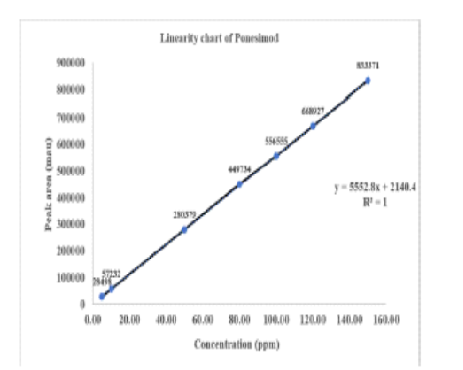
Ponesimod is a second-generation, orally active, highly selective sphingosine-1-phosphate receptor-1 (S1P₁) modulator. The quantitative detection of sphingosine-1-phosphate receptor modulators, especially in biological matrices, has been achieved by use of various chromatographic techniques. Following the latest ICH Q2(R2) guidelines, this study aimed to create and test an RP-HPLC method for the quantitative measurement of Ponesimod in both bulk medication and commercially available tablet dosage forms that was easy to use, fast, cheap, and reliable. Chromatographic separation was achieved by using a YMC Triart C18 column (250 × 4.6 mm, 5 μm) maintained at 25°C and an isocratic mobile phase containing 10 mM ammonium bicarbonate and acetonitrile (60:40, % volume by volume) supplied at a flow rate of 0.5 mL min⁻¹. Eluting ponesimod at 6.517 minutes resulted in column efficiency of 6540 theoretical plates and excellent peak asymmetry of 1.34. The method showed remarkable linearity over the concentration range of 5-150 μg mL⁻¹, as evidenced R² = 0.9999. Intermediate precision has a %RSD of 0.0234% and repeatability of 0.04%. Mean recoveries of 99.04% at the 50% level, 99.45% at the 100% level, and 101.15% at the 150% level proved the excellent analytical accuracy. The limits of detection (LOD) were 0.30 ng mL⁻¹ and 1.00 ng mL⁻¹, respectively, with mean signal-to-noise ratios of 6.94 and 40.36. The fact that the chromatographic performance remained mostly unchanged after deliberately adjusting the flow rate and column temperature demonstrates outstanding robustness. When the process was applied to Ponvory® pills, an assay result of 101.43% was obtained. With great precision, accuracy, sensitivity, and durability, the RP-HPLC technology performed well. Its user-friendliness, fast analytical time, and cost-effective chromatographic conditions make it a great choice for quantitative evaluation of Ponesimod in Ponvory 20 mg and for periodic quality monitoring.
Keywords: Ponesimod; ICH Q2(R2); Pharmaceutical quality control; Analytical method validation; Sphingosine-1-phosphate receptor modulator
1. Alnaif A, Oiler I, D'Souza MS. Ponesimod: An Oral Second-Generation Selective Sphingosine 1-Phosphate Receptor Modulator for the Treatment of Multiple Sclerosis. Annals of Pharmacotherapy. 2023; 57 (8). Available from: https://doi.org/10.1177/10600280221140480
2. Brossard P, Derendorf H, Xu J, Maatouk H, Halabi A, Dingemanse J. Pharmacokinetics and pharmacodynamics of ponesimod, a selective S1P1 receptor modulator, in the first‐in‐human study. British Journal of Clinical Pharmacology. 2013; 76 (6). Available from: https://doi.org/10.1111/bcp.12129
3. Olsson T, Boster A, Fernández Ó, Freedman MS, Pozzilli C, Bach D, et al. Oral ponesimod in relapsing-remitting multiple sclerosis: a randomised phase II trial. Journal of Neurology, Neurosurgery & Psychiatry. 2014; 85 (11). Available from: https://doi.org/10.1136/jnnp-2013-307282
4. Kappos L, Fox RJ, Burcklen M, Freedman MS, Havrdová EK, Hennessy B. Ponesimod Compared With Teriflunomide in Patients With Relapsing Multiple Sclerosis in the Active-Comparator Phase 3 OPTIMUM Study. JAMA Neurology. 2021; 78 (5). Available from: https://doi.org/10.1001/jamaneurol.2021.0405
5. Jones RR, Turkoz I, Ait-Tihyaty M, DiBernardo A, Houtchens MK, Havrdová EK. Efficacy and Safety of Ponesimod Compared with Teriflunomide in Female Patients with Relapsing Multiple Sclerosis: Findings from the Pivotal OPTIMUM Study. Journal of Women's Health. 2024; 33 (4). Available from: https://doi.org/10.1089/jwh.2023.0037
6. Susha C, Afsaneh K. High Performance Liquid Chromatography (HPLC). J New Medical Life Sci.. 2018.
7. Vidushi Y, Meenakshi B. A review on HPLC method development and validation. Research Journal of Life Sciences, Bioinformatics, Pharmaceutical and Chemical Sciences. 2017; 2 (6). Available from: https://doi.org/10.26479/2017.0206.12
8. Snyder LR, Dolan JW. High-Performance Gradient Elution: The Practical Application of the Linear-Solvent-Strength Model. Hoboken: Wiley-Interscience. 2006; Available from: https://doi.org/10.1002/0470055529
9. Engelhardt H. High Performance Liquid Chromatography. Berlin: Springer; 2012.
10. Ramalingam P, Bhadraya K, Reddy YP. Analytical Quality by Design: A Tool for Regulatory Flexibility and Robust Analytics. International Journal of Analytical Chemistry. 2015; 2015 Available from: https://doi.org/10.1155/2015/868727
11. Dash RP, Srinivas NR, Rais R. A review of bioanalytical quantitative methods for selected sphingosine 1‐phosphate receptor modulators. Biomedical Chromatography. 2018; 32 (1). Available from: https://doi.org/10.1002/bmc.4109
12. International Council for Harmonisation (ICH). ICH Harmonised Guideline Q2(R2): Validation of Analytical Procedures. Geneva: ICH; 2023.
13. International Council for Harmonisation (ICH). ICH Harmonised Guideline Q14: Analytical Procedure Development. Geneva: ICH; 2023.
14. Brossard P, Derendorf H, Xu J, Maatouk H, Halabi A, Dingemanse J. Pharmacokinetics and pharmacodynamics of ponesimod, a selective S1P1 receptor modulator, in the first‐in‐human study. British Journal of Clinical Pharmacology. 2013; 76 (6). Available from: https://doi.org/10.1111/bcp.12129
© 2026 Published by Krupanidhi College of Pharmacy. This is an open-access article under the CC BY-NC-ND license (https://creativecommons.org/licenses/by-nc-nd/4.0/)
Subscribe now for latest articles and news.