Journal of Pharmaceutical Research
DOI: 10.18579/jopcr/v25.i4.135
Year: 2026, Volume: 25, Issue: 4, Pages: 209-218
Systematic Review
Yogesh S Ahire1, Rakesh S Ahire2*, Vaishnavi D Jadhav3, Pankaj S Patil4
1Associate Professor, Department of Pharmacology, KBHSS Trust’s Institute of Pharmacy, Malegaon, Dist. Nashik, Maharashtra, India
2Research Scholar, Department of Pharmacology, KBHSS Trust’s Institute of Pharmacy, Malegaon, Dist. Nashik, Maharashtra, India
3Research Scholar, Department of Pharmacology, MGV’s Pharmacy College Panchavati, Nashik, Maharashtra, India
4Associate Professor, Department of Pharmacology, MGV’s Pharmacy College Panchavati, Nashik, Maharashtra, India
*Corresponding author. Rakesh S Ahire
Email: [email protected]

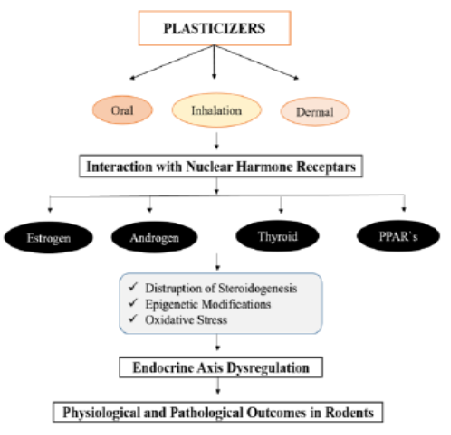
This study focuses on the potential impact of plasticizers on hormones in the body, as they are a common component of numerous plastic items. The research looks at the detrimental effects of traditional phthalate plasticizers including DEHP, DBP and BBP as well as newer non-phthalate alternatives on the reproductive system, brain, thyroid and adrenal glands by reviewing several studies that have been conducted on rodents. The results indicate that these chemicals can induce significant endocrine disruption, particularly in the early development and pregnancy. Male offspring of those exposed to plasticisers had reproductive abnormalities including decreased anogenital distance and disrupted hormone production, and females had lower fertility, irregular reproductive cycles, and changes in ovarian structure. The study also documents behavioural changes, brain development issues and thyroid and adrenal hormone dysfunction. It was discovered that these impacts can last long-term and impact future generations. The study also notes how plasticizers disrupt the binding of hormones to their receptors, processes that involve enzymes that are crucial to the production of hormones, and the regulation of genes. While the study primarily focused on rodents, it offers compelling evidence showing that plasticizers could be a significant health concern for humans, and further research and safety measures are warranted.
Keywords: Phthalates, Microplastics, Endocrine disruption, Environmental exposure, Reproductive toxicity, Hormonal imbalance
1. Gore AC, Chappell VA, Fenton SE, Flaws JA, Nadal A, Prins GS, et al. EDC-2: The Endocrine Society's Second Scientific Statement on Endocrine-Disrupting Chemicals. Endocrine Reviews. 2015; 36 (6). Available from: https://doi.org/10.1210/er.2015-1010
2. Cole M, Lindeque P, Halsband C, Galloway TS. Microplastics as contaminants in the marine environment: A review. Marine Pollution Bulletin. 2011; 62 (12). Available from: https://doi.org/10.1016/j.marpolbul.2011.09.025
3. Diamanti-Kandarakis E, Bourguignon JP, Giudice LC, Hauser R, Prins GS, Soto AM, et al. Endocrine-Disrupting Chemicals: An Endocrine Society Scientific Statement. Endocrine Reviews. 2009; 30 (4). Available from: https://doi.org/10.1210/er.2009-0002
4. Zoeller RT, Brown TR, Doan LL, Gore AC, Skakkebaek NE, Soto AM, et al. Endocrine-Disrupting Chemicals and Public Health Protection: A Statement of Principles from The Endocrine Society. Endocrinology. 2012; 153 (9). Available from: https://doi.org/10.1210/en.2012-1422
5. Andrady AL. Microplastics in the marine environment. Marine Pollution Bulletin. 2011; 62 (8). Available from: https://doi.org/10.1016/j.marpolbul.2011.05.030
6. Abbasi A, Abtahi M, Arfaeinia H. Leaching of endocrine-disrupting chemicals from plastic water bottles: a global concern. Environmental Pollution. 2024;345:123456.
7. Flora G, Stephy GM, Veeramuthu A. The Rise of non-phthalate plasticizers: Serious risks to human life and environmental consequences – A comprehensive review. Journal of Environmental Chemical Engineering. 2025; 13 (3). Available from: https://doi.org/10.1016/j.jece.2025.115976
8. Hasan M, Ali R, Rahman MM, et al. Environmental PAEs and their multi-route entry into the human system. Environmental Research. 2025; 267 (Pt 2). Available from: https://doi.org/10.1016/j.envres.2025.121393
9. Pal N, Sharma P, Singh S, Ojha R, Kumawat M, Shubham S, et al. Detection and risk assessment of bisphenol-A and phthalate esters in bottled water: implications for public health. International Journal of Environmental Health Research. 2025; 35 (10). Available from: https://doi.org/10.1080/09603123.2025.2465855
10. Wei W, Mansouri A, Zoutendijk SL, Langer S, Liagkouridis I, Hopf NB, et al. Plasticizer sources and concentrations in indoor environments in Europe: A systematic review of existing data. Science of The Total Environment. 2025; 972 Available from: https://doi.org/10.1016/j.scitotenv.2025.179080
11. Wang P, Han L, Zou H, Cao Y, Gao X, Ren H, et al. Evaluation of urinary metabolites as biomarkers for occupational p-chloronitrobenzene exposure: a pilot study. Scientific Reports. 2025; 15 (1). Available from: https://doi.org/10.1038/s41598-025-96891-x
12. Vaezafshar S, Wolk S, Simpson K, Akhbarizadeh R, Blum A, Jantunen LM, et al. Are Sleeping Children Exposed to Plasticizers, Flame Retardants, and UV-Filters from Their Mattresses?. Environmental Science & Technology. 2025; 59 (16). Available from: https://doi.org/10.1021/acs.est.5c03560
13. Tyl RW, Myers CB, Marr MC, Sloan CS, Castillo NP, Veselica MM, et al. Three-generation reproductive toxicity study of dietary DEHP in rats. Reproductive Toxicology. 2009; 27 (3-4). Available from: https://doi.org/10.1016/j.reprotox.2008.10.011
14. Gray LE Jr, Ostby J, Furr J, Price M, Veeramachaneni DN, Parks L. Perinatal exposure to phthalates: effects on male reproductive development. Toxicological Sciences. 2000; 58 (2). Available from: https://doi.org/10.1093/toxsci/58.2.339
15. Vom Saal FS, Akingbemi BT, Belcher SM, Birnbaum LS, Crain DA, Eriksen M, et al. Chapel Hill bisphenol A expert panel consensus statement: Integration of mechanisms, effects in animals and potential to impact human health at current levels of exposure. Reproductive Toxicology. 2007; 24 (2). Available from: https://doi.org/10.1016/j.reprotox.2007.07.005
16. Gorini F, Tonacci A, Sanmartin C, Venturi F. Phthalates and Non-Phthalate Plasticizers and Thyroid Dysfunction: Current Evidence and Novel Strategies to Reduce Their Spread in Food Industry and Environment. Toxics. 2025; 13 (3). Available from: https://doi.org/10.3390/toxics13030222
17. Manikkam M, Tracey R, Guerrero-Bosagna C, Skinner MK. Transgenerational actions of DEHP on male fertility in rats. Endocrinology. 2013; 154 (3). Available from: https://doi.org/10.1210/en.2012-1601
18. Adam N, Mhaouty-Kodja S. Behavioral Effects of Exposure to Phthalates in Female Rodents: Evidence for Endocrine Disruption?. International Journal of Molecular Sciences. 2022; 23 (5). Available from: https://doi.org/10.3390/ijms23052559
19. Panagiotidou E, Zerva S, Mitsiou DJ, Alexis MN, Kitraki E. Perinatal exposure to low-dose bisphenol A affects the neuroendocrine stress response in rats. Journal of Endocrinology. 2014; 220 (3). Available from: https://doi.org/10.1530/joe-13-0416
20. Cariati F, Carbone L, Conforti A, Bagnulo F, Peluso SR, Carotenuto C, et al. Bisphenol A-Induced Epigenetic Changes and Its Effects on the Male Reproductive System. Frontiers in Endocrinology. 2020; 11 Available from: https://doi.org/10.3389/fendo.2020.00453
21. Barakat R, Lin PC, Park CJ, Best-Popescu C, Bakry HH, Abuelela S, et al. Germline-dependent transmission of male reproductive traits induced by an endocrine disruptor, di-2-ethylhexyl phthalate, in future generations. Scientific Reports. 2020; 10 (1). Available from: https://doi.org/10.1038/s41598-020-62584-w
22. Grindler NM, Vanderlinden L, Karthikraj R, Kannan K, Teal S, Polotsky AJ, et al. Exposure to Phthalate, an Endocrine Disrupting Chemical, Alters the First Trimester Placental Methylome and Transcriptome in Women. Scientific Reports. 2018; 8 (1). Available from: https://doi.org/10.1038/s41598-018-24505-w
23. Stratmann M, Özel F, Marinopoulou M, Lindh C, Kiviranta H, Gennings C, et al. Prenatal exposure to endocrine disrupting chemicals and the association with behavioural difficulties in 7-year-old children in the SELMA study. Journal of Exposure Science & Environmental Epidemiology. 2025; 35 (6). Available from: https://doi.org/10.1038/s41370-024-00739-x
24. Mathieu-Denoncourt J, Wallace SJ, De Solla SR, Langlois VS. Plasticizer endocrine disruption: Highlighting developmental and reproductive effects in mammals and non-mammalian aquatic species. General and Comparative Endocrinology. 2015; 219 Available from: https://doi.org/10.1016/j.ygcen.2014.11.003
25. Lucaccioni L, Trevisani V, Passini E, Righi B, Plessi C, Predieri B, et al. Perinatal Exposure to Phthalates: From Endocrine to Neurodevelopment Effects. International Journal of Molecular Sciences. 2021; 22 (8). Available from: https://doi.org/10.3390/ijms22084063
26. Singh A, Khan GN, Choudhury M, Rai PS, Kabekkodu SP. Phthalates and epigenetics: An emerging public health concern. Current Research in Toxicology. 2025; 9 Available from: https://doi.org/10.1016/j.crtox.2025.100267
27. Forner-Piquer I, Baig AH, Kortenkamp A. Disruption of the thyroid hormone system and patterns of altered thyroid hormones after gestational chemical exposures in rodents – a systematic review. Frontiers in Endocrinology. 2024; 14 Available from: https://doi.org/10.3389/fendo.2023.1323284
28. Li Z, Robaire B. Effects of Endocrine-Disrupting Chemicals on Adrenal Function. Endocrinology. 2025; 166 (4). Available from: https://doi.org/10.1210/endocr/bqaf045
29. Stathori G, Hatziagapiou K, Mastorakos G, Vlahos NF, Charmandari E, Valsamakis G. Endocrine-Disrupting Chemicals, Hypothalamic Inflammation and Reproductive Outcomes: A Review of the Literature. International Journal of Molecular Sciences. 2024; 25 (21). Available from: https://doi.org/10.3390/ijms252111344
© 2026 Published by Krupanidhi College of Pharmacy. This is an open-access article under the CC BY-NC-ND license (https://creativecommons.org/licenses/by-nc-nd/4.0/)
Subscribe now for latest articles and news.