Journal of Pharmaceutical Research
DOI: 10.18579/jopcr/v25.i4.165
Year: 2026, Volume: 25, Issue: 4, Pages: 219-228
Systematic Review
Renu Kumari1, Nirmal Dongre2, Souravh Bais3*
1Research Scholar, Department of Pharmacology, Institute of Pharmaceutical Sciences, SAGE University, Indore, Madhya Pradesh, India
2Professor, Department of Pharmacognosy, Institute of Pharmacy, SAGE University, Indore, Madhya Pradesh, India
3Professor, Department of Pharmacology, Institute of Pharmaceutical Sciences, SAGE University, Indore, Madhya Pradesh, India
*Corresponding Author
Email: [email protected]

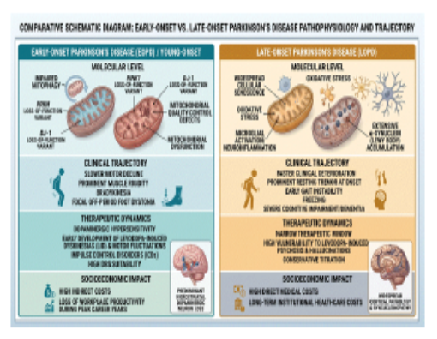
Parkinson's disease (PD) is a progressive neurodegenerative disorder with marked clinical heterogeneity influenced by age at disease onset. Early-Onset Parkinson's Disease (EOPD), typically diagnosed before 50 years of age, differs substantially from Late-Onset Parkinson's Disease (LOPD) in its genetic basis, clinical manifestations, disease progression, therapeutic response, and socioeconomic consequences. A systematic comparative review was conducted in accordance with the Preferred Reporting Items for Systematic Reviews and Meta-Analyses (PRISMA) guidelines. Published comparative cohort studies, epidemiological investigations, systematic reviews, and related clinical studies evaluating EOPD and LOPD were identified through searches of PubMed/MEDLINE, Web of Science, and Google Scholar. Eligible studies were selected using predefined PICOS criteria, and the available evidence was synthesized primarily through narrative analysis because of methodological and clinical heterogeneity across studies. The reviewed evidence demonstrates that EOPD is strongly associated with monogenic mutations, particularly PRKN, PINK1, DJ-1, and LRRK2, whereas LOPD is predominantly influenced by aging-related neurodegenerative mechanisms and cumulative environmental exposures. Individuals with EOPD generally exhibit slower disease progression, better preservation of cognitive function, and greater responsiveness to dopaminergic therapy but experience a higher incidence of levodopa-induced dyskinesia and motor fluctuations during long-term treatment. In contrast, LOPD is characterized by accelerated clinical progression, greater cognitive decline, psychosis, autonomic dysfunction, gait impairment, and increased healthcare utilization. Deep Brain Stimulation demonstrates greater suitability and long-term benefit in carefully selected patients with EOPD, while socioeconomic burden differs substantially between the two groups, with indirect productivity loss predominating in EOPD and direct medical costs being more prominent in LOPD. EOPD and LOPD represent biologically and clinically distinct phenotypes of Parkinson's disease that require individualized diagnostic approaches, age-specific therapeutic strategies, and targeted long-term management. Future research should emphasize standardized age-at-onset definitions, longitudinal cohort studies, and the development of precision medicine approaches to improve outcomes across both patient populations.
Keywords: Early-Onset Parkinson's Disease; Late-Onset Parkinson's Disease; Parkinson's Disease; Age at Onset; Levodopa-Induced Dyskinesia; Deep Brain Stimulation
1. Kalia LV, Lang AE. Parkinson's disease. The Lancet. 2015; 386 (9996). Available from: https://doi.org/10.1016/s0140-6736(14)61393-3
2. Poewe W, Seppi K, Tanner CM, Halliday GM, Brundin P, Volkmann J, et al. Parkinson disease. Nature Reviews Disease Primers. 2017; 3 (1). Available from: https://doi.org/10.1038/nrdp.2017.13
3. Bloem BR, Okun MS, Klein C. Parkinson's disease. The Lancet. 2021; 397 (10291). Available from: https://doi.org/10.1016/s0140-6736(21)00218-x
4. de Lau LM, Breteler MM. Epidemiology of Parkinson's disease. The Lancet Neurology. 2006; 5 (6). Available from: https://doi.org/10.1016/s1474-4422(06)70471-9
5. Schrag A, Ben-Shlomo Y, Quinn NP. Cross sectional prevalence survey of idiopathic Parkinson's disease and parkinsonism in London. BMJ. 2000; 321 (7252). Available from: https://doi.org/10.1136/bmj.321.7252.21
6. Klein C, Westenberger A. Genetics of Parkinson's Disease. Cold Spring Harbor Perspectives in Medicine. 2012; 2 (1). Available from: https://doi.org/10.1101/cshperspect.a008888
7. Blauwendraat C, Nalls MA, Singleton AB. The genetic architecture of Parkinson's disease. The Lancet Neurology. 2020; 19 (2). Available from: https://doi.org/10.1016/s1474-4422(19)30287-x
8. Kasten M, Klein C. The many faces of genetic Parkinson's disease. Journal of Neurochemistry. 2013;125(4):494–501.
9. Dauer W, Przedborski S. Parkinson's disease: mechanisms and models. Neuron. 2003; 39 (6). Available from: https://doi.org/10.1016/s0896-6273(03)00568-3
10. Surmeier DJ, Obeso JA, Halliday GM. Selective neuronal vulnerability in Parkinson disease. Nature Reviews Neuroscience. 2017; 18 (2). Available from: https://doi.org/10.1038/nrn.2016.178
11. Schapira AHV, Jenner P. Etiology and pathogenesis of Parkinson's disease. Movement Disorders. 2011; 26 (6). Available from: https://doi.org/10.1002/mds.23732
12. Obeso JA, Stamelou M, Goetz CG, Poewe W, Lang AE, Weintraub D, et al. Past, present, and future of Parkinson's disease: A special essay on the 200th anniversary of the Shaking Palsy. Movement Disorders. 2017; 32 (9). Available from: https://doi.org/10.1002/mds.27115
13. Postuma RB, Berg D, Stern M, Poewe W, Olanow CW, Oertel W, et al. MDS clinical diagnostic criteria for Parkinson's disease. Movement Disorders. 2015; 30 (12). Available from: https://doi.org/10.1002/mds.26424
14. Armstrong MJ, Okun MS. Diagnosis and Treatment of Parkinson Disease. JAMA. 2020; 323 (6). Available from: https://doi.org/10.1001/jama.2019.22360
15. Fox SH, Katzenschlager R, Lim SY, Barton B, de Bie RMA, Seppi K, et al. International Parkinson and movement disorder society evidence‐based medicine review: Update on treatments for the motor symptoms of Parkinson's disease. Movement Disorders. 2018; 33 (8). Available from: https://doi.org/10.1002/mds.27372
16. Connolly BS, Lang AE. Pharmacological Treatment of Parkinson Disease. JAMA. 2014; 311 (16). Available from: https://doi.org/10.1001/jama.2014.3654
17. Olanow CW, Stern MB, Sethi K. The scientific and clinical basis for the treatment of Parkinson disease (2009). Neurology. 2009; 72 (21_supplement_4). Available from: https://doi.org/10.1212/wnl.0b013e3181a1d44c
18. Rascol O, Brooks DJ, Korczyn AD, De Deyn PP, Clarke CE, Lang AE. A Five-Year Study of the Incidence of Dyskinesia in Patients with Early Parkinson's Disease Who Were Treated with Ropinirole or Levodopa. New England Journal of Medicine. 2000; 342 (20). Available from: https://doi.org/10.1056/nejm200005183422004
19. Schuepbach WMM, Rau J, Knudsen K, Volkmann J, Krack P, Timmermann L, et al. Neurostimulation for Parkinson's disease with early motor complications. New England Journal of Medicine. 2013; 368 (7). Available from: https://doi.org/10.1056/NEJMoa1205158
20. Deuschl G, Schade-Brittinger C, Krack P, Volkmann J, Schäfer H, Bötzel K, et al. A Randomized Trial of Deep-Brain Stimulation for Parkinson's Disease. New England Journal of Medicine. 2006; 355 (9). Available from: https://doi.org/10.1056/nejmoa060281
21. Weaver FM, Follett K, Stern M, Hur K, Harris C, Marks WJ Jr, et al. Bilateral Deep Brain Stimulation vs Best Medical Therapy for Patients With Advanced Parkinson DiseaseA Randomized Controlled Trial. JAMA. 2009; 301 (1). Available from: https://doi.org/10.1001/jama.2008.929
22. Marras C, Beck JC, Bower JH, Roberts E, Ritz B, Ross GW, et al. Prevalence of Parkinson’s disease across North America. npj Parkinson's Disease. 2018; 4 (1). Available from: https://doi.org/10.1038/s41531-018-0058-0
23. Hely MA, Reid WGJ, Adena MA, Halliday GM, Morris JGL. The Sydney multicenter study of Parkinson's disease: The inevitability of dementia at 20 years. Movement Disorders. 2008; 23 (6). Available from: https://doi.org/10.1002/mds.21956
24. Wickremaratchi MM, Ben-Shlomo Y, Morris HR. The effect of onset age on the clinical features of Parkinson’s disease. European Journal of Neurology. 2009; 16 (4). Available from: https://doi.org/10.1111/j.1468-1331.2008.02514.x
25. Mehanna R, Jankovic J. Young-onset Parkinson's disease: Its unique features and management. Parkinsonism & Related Disorders. 2019; 65 Available from: https://doi.org/10.1016/j.parkreldis.2019.06.001
26. Schrag A, Hovris A, Morley D, Quinn N, Jahanshahi M. Caregiver-burden in parkinson's disease is closely associated with psychiatric symptoms, falls, and disability. Parkinsonism & Related Disorders. 2006; 12 (1). Available from: https://doi.org/10.1016/j.parkreldis.2005.06.011
27. Dorsey ER, Elbaz A, Nichols E, Abd-Allah F, Abdelalim A, Adsuar JC, et al. Global, regional, and national burden of suicide mortality 1990 to 2016: systematic analysis for the Global Burden of Disease Study 2016. BMJ. 2019; Available from: https://doi.org/10.1136/bmj.l94
28. Dorsey ER, Sherer T, Okun MS, Bloem BR. The Emerging Evidence of the Parkinson Pandemic. Journal of Parkinson’s Disease. 2018; 8 (s1). Available from: https://doi.org/10.3233/jpd-181474
29. Tolosa E, Garrido A, Scholz SW, Poewe W. Challenges in the diagnosis of Parkinson's disease. The Lancet Neurology. 2021; 20 (5). Available from: https://doi.org/10.1016/s1474-4422(21)00030-2
30. Sveinbjornsdottir S. The clinical symptoms of Parkinson's disease. Journal of Neurochemistry. 2016; 139 (S1). Available from: https://doi.org/10.1111/jnc.13691
© 2026 Published by Krupanidhi College of Pharmacy. This is an open-access article under the CC BY-NC-ND license (https://creativecommons.org/licenses/by-nc-nd/4.0/)
Subscribe now for latest articles and news.