Journal of Pharmaceutical Research
Year: 2026, Volume: 25, Issue: 3, Pages: 141-145
Review Article
P M Vasanth Kumar1, S Tejaswini2, G Praveen2, N Jahnavi2, A Areefa2
1Faculty, SVU College of Pharmaceutical Sciences, Sri Venkateswara University, Tirupati-517502, Andhra Pradesh, India
2SVU College of Pharmaceutical Sciences, Sri Venkateswara University, Tirupati- 517502, Andhra Pradesh, India

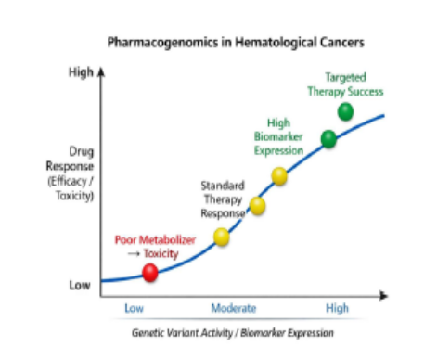
Hematological malignancies, including acute and chronic leukemias, lymphomas, and multiple myeloma, continue to present clinicians with diverse responses to traditional chemotherapies and kinase inhibitors due to myelosuppression, off-target effects, and acquired resistance. Pharmacogenomics lets you choose the right dose and regimen by showing how changes in important genes in the germ line affect pharmacokinetics, transporter activity, and target engagement. Critical pharmacogenes encompass ABC transporters (ABCB1, ABCC1) linked to multidrug efflux and relapse risk; cytochrome P450 isoforms (e.g., CYP2C19, CYP3A5) that affect tyrosine kinase inhibitor clearance; and TPMT and NUDT15, which are involved in thiopurine metabolism in acute lymphoblastic leukemia (ALL), where deficient variants lead to severe neutropenia. Pre-emptive genotyping has proven effective in diminishing toxicity rates, as evidenced by juvenile acute lymphoblastic leukemia datasets, achieving a 40–60% reduction in thiopurine-related events and enhancing event-free survival through tailored dosing. High initial costs, low-quality assays, limited access in low-resource areas, and equity disparities among diverse ancestries where NUDT15 variations are common continue to be challenges. Emerging multigene panels, AI-enhanced interpretation, and real-world data from initiatives such as the 100,000 Genomes Project promise improved remission rates and quality of life, indicating potential for further integration.
Keywords: Reducing drug toxicity, Variations in TPMT/NUDT15, Precision oncology, Pharmacogenomics, Blood cancers
1. Swerdlow SH, Campo E, Pileri SA, Harris NL, Stein H, Siebert R. The 2016 revision of the World Health Organization classification of lymphoid neoplasms. Blood. 2016; 127 (20). Available from: https://doi.org/10.1182/blood-2016-01-643569
2. Tanaka Y. Pharmacogenomics in hematological malignancy. Rinsho Ketsueki. 2022; 63 (10). Available from: https://doi.org/10.11406/rinketsu.63.1353
3. Maillard N, Guillemain J, Picard N, Loriot MA, Picard V, Del Bello A, et al. Pharmacogenomics in Solid Tumors and Blood Cancers: Making precision medicine fit your needs. Research in pharmacology. 176:106047, 2022.
4. Leong IUS, Cabrera CP, Cipriani V, Ross PJ, Turner RM, Stuckey A. Large-Scale Pharmacogenomics Analysis of Patients With Cancer Within the 100,000 Genomes Project Combining Whole-Genome Sequencing and Medical Records to Inform Clinical Practice. Journal of Clinical Oncology. 2025; 43 (6). Available from: https://doi.org/10.1200/jco.23.02761
5. Lubis IS, Anggadiredja K, Artarini AA, Sari NM, Suryawan N, Zazuli Z. NUDT15 Pharmacogenetics in Acute Lymphoblastic Leukemia: Synthesizing Progress for Personalized Thiopurine Therapy. Medical Sciences. 2025; 13 (3). Available from: https://doi.org/10.3390/medsci13030112
6. Sánchez-Bayona R, Catalán C, Cobos MA, Bergamino M. Pharmacogenomics in Solid Tumors: A Comprehensive Review of Genetic Variability and Its Clinical Implications. Cancers. 2025; 17 (6). Available from: https://doi.org/10.3390/cancers17060913
7. Cheok MH, Pottier N, Kager L, Evans WE. Pharmacogenetics in acute lymphoblastic leukemia. Seminars in Hematology. 2009; 46 (1). Available from: https://doi.org/10.1053/j.seminhematol.2008.09.002
8. Mai N, Fernandez N, Drilon A, Chakravarty D. Precision Oncology: 2025 in Review. Cancer Discovery. 2025; 15 (12). Available from: https://doi.org/10.1158/2159-8290.cd-25-1784
9. Zhang N, Wu J, Wang Q, Liang Y, Li X, Chen G, et al. Global burden of hematologic malignancies and evolution patterns over the past 30 years. Blood Cancer Journal. 2023; 13 (1). Available from: https://doi.org/10.1038/s41408-023-00853-3
10. Kumbhakar DV, Thakkar L, Akhand C, Sharaf S, Vemuganti GK. Nanomaterials targeting cancer stem cells to overcome drug resistance and tumor recurrence. Frontiers in Oncology. 2025; 15 Available from: https://doi.org/10.3389/fonc.2025.1499283
11. Fokhrul Hossain, Samarpan Majumder, Justin David, Lucio Miele. Precision Medicine and Triple-Negative Breast Cancer: Current Landscape and Future Directions. Cancers. 2021; 13 (15). Available from: https://doi.org/10.3390/cancers13153739
12. Pan T, Zhang J, Wang X, Song Y. Global burden and trends of hematologic malignancies based on Global Cancer Observatory 2022 and Global Burden of Disease 2021. Experimental Hematology & Oncology. 2025; 14 Available from: https://doi.org/10.1186/s40164-025-00684-x
13. Escalante-Bautista D, Haydeé RV, Cerecedo D. Novel Aspects of Leukemia Pharmacogenomics. Leukemia. 2022; Available from: https://doi.org/10.36255/exon-publications-leukemia-pharmacogenomics
14. A Decade of Progress: Transformative Advances in Blood Cancer. AACR Cancer Progress Report. 2025; Available from: https://cancerprogressreport.aacr.org/wp-content/uploads/sites/2/2025/09/AACR_CPR_2025.pdf
15. Sun K, Wu H, Zhu Q, Gu K, Wei H, Wang S, et al. Global landscape and trends in lifetime risks of haematologic malignancies in 185 countries: population-based estimates from GLOBOCAN 2022. eClinicalMedicine. 2025; 83 Available from: https://doi.org/10.1016/j.eclinm.2025.103193
© 2026 Published by Krupanidhi College of Pharmacy. This is an open-access article under the CC BY-NC-ND license (https://creativecommons.org/licenses/by-nc-nd/4.0/)
Subscribe now for latest articles and news.