• P-ISSN 0973-7200 E-ISSN 2454-8405
  • Follow us

Journal of Pharmaceutical Research

Article

Journal of Pharmaceutical Research

Year: 2023, Volume: 22, Issue: 1, Pages: 1-7

Review Article

Neem (Azadirachta indica): A Panacea of all Diseases

Abstract

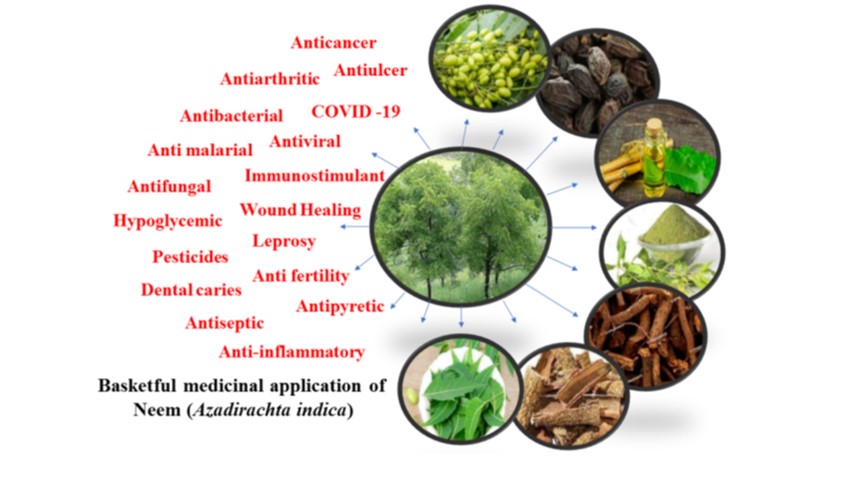
Neem (Azadirachta indica) belongs to the Meliaceae family. Neem is well-known around the world for its medicinal and nutritional properties. Various parts of the plant like fruits, leaves, flowers, twigs, gum, seed, oil, bark, and root are known to have medicinal properties and are scientifically established for the various properties. Since ancient times, plant’s parts have been utilized for their medicinal value. The plant contains a high amount of catalase (CAT), peroxidase (POD), polyphenol oxidase (PPO) and ascorbate peroxidase (APX) enzyme, and many other phytoconstituents such as isoprenoid-containing protomeliacins, limonoids, azadirone and Csecomeliacins such as azadirachtin, nimbin, and salanin. The non-isoprenoids include sulphurous compounds, polyphenolics like flavonoids and their glycosides, dihydrochalcone, coumarin and tannins, proteins (amino acids) and carbohydrates (polysaccharides), as well as aliphatic compounds. Due to such type of versatile phytoconstituents, the plants show lots of pharmacological applications. In this review article, we summarized the information regarding the various pharmacological activities of neem plants. All information presented in this review article regarding the beneficial application of Neem (Azadirachta indica) has been acquired by imminent various electronic databases including Scopus, Google scholar, Science Direct, Web of Science, and PubMed. The Neem plant, including leaves, bark, latex, seed, and their active constituents, plays a significant part in the management of progressive illness. The neem plant contains active ingredients were accountable for the basketful therapeutic function such as anticancer, anti-inflammatory, antidiabetic, antispasmodic, antifungal, antioxidant, antimicrobial, antimalarial, antifertility, and also helps in proper digestion, hair growth, skin related problems and relief in menstrual pain and many more. The main findings showed that neem has strong medicinal properties and is also useful in cosmetic applications. There is no evidence of adverse effects of neem in literature. Only the people who are allergic to it can have side effects otherwise it is stomach friendly in all conditions due to which it can be applicable for treatment of various health related disorders.


Keywords: Neem (Azadirachta indica), Phytochemical constituents, Therapeutic application

References

  1. Maithani A, Parcha V, Pant G, Dhulia I, Kumar D. Azadirachta indica (neem) leaf: A review. J Pharm Res. 2011;4(6):1824–1831.
  2. Paul R, Prasad M, Sah NK. Anticancer biology of Azadirachta indica L (neem): A mini review. Cancer Biology & Therapy. 2011;12(6):467–476. Available from: https://doi.org/10.4161/cbt.12.6.16850
  3. Atawodi SE, Atawodi JC. Azadirachta indica (neem): a plant of multiple biological and pharmacological activities. Phytochemistry Reviews. 2009;8(3):601–620. Available from: https://doi.org/10.1007/s11101-009-9144-6
  4. Brahmachari G. Neem - An Omnipotent Plant: A Retrospection. ChemBioChem. 2004;5(4):408–421. Available from: https://doi.org/10.1002/cbic.200300749
  5. Giri RP, Gangawane DAK, Giri DSG. Neem the Wonder Herb: A Short Review. International Journal of Trend in Scientific Research and Development. 2019;3(3):962–967. Available from: https://gethugg.com/wp-content/uploads/2021/10/Neem_the_Wonder_Herb_A_Short_Review.pdf
  6. Reddy IVS, Neelima P. Neem (Azadirachta indica): A Review on Medicinal Kalpavriksha. International Journal of Economic Plants. 2022;9(1):059–063. Available from: https://www.pphouse.org/upload_article/60784685_11_IJEP_2022_9_1_Reddy_and_Neelima.pdf
  7. Barman P, Ahmed N, Chakraborty D. Neem - A Cynosure of Modern Medicine: A Review. International Journal of Livestock Research. 2019;9(0):1–7. Available from: https://ijlr.org/issue/neem-a-cynosure-of-modern-medicine-a-review/?key=download
  8. Baby AR, Freire TB, Marques GDA, Rijo P, Lima FV, Carvalho JCMD, et al. Azadirachta indica (Neem) as a Potential Natural Active for Dermocosmetic and Topical Products: A Narrative Review. Cosmetics. 2022;9(3):58. Available from: https://doi.org/10.3390/cosmetics9030058
  9. Md SU, Nahar ANZ, Md. Khorshed and Hoq Obydul. Neem (Azadirachta indica) in health care: A review. International Journal of Unani and Integrative Medicine. 2018;2(2):81–87. Available from: https://www.unanijournal.com/articles/30/2-2-8-302.pdf
  10. Subapriya R, Nagini S. Medicinal properties of neem leaves: a review. Curr Med Chem Anticancer Agents. 2005;5(2):149–156. Available from: https://doi.org/10.2174/1568011053174828
  11. Biosci IJ, Nishan M, Subramanian P. Pharmacological and non pharmacological activity of Azadirachta indica ( Neem ) - A review. Int J Biosci. 2014;5(6):104–116.
  12. Rashed Z, KN. Biological Activities of Isorhamnetin: A Review. Plantae Sci. 2020;3(5):78–81.
  13. Lakshmi T, Krishnan V, Rajendran R, Madhusudhanan N. Azadirachta indica : A herbal panacea in dentistry - An update. Pharmacognosy Reviews. 2015;9(17):41–44. Available from: https://doi.org/10.4103%2F0973-7847.156337
  14. Areh ET, Atolani O, Kambizi L. In silico Evaluation of the Antimalarial Potential of the Phytoconstituents of the Azadirachta indica Plant. Al-Bahir Journal for Engineering and Pure Sciences. 2022;1(1). Available from: https://doi.org/10.55810/2312-5721.1004
  15. Nand P, Drabu S, Gupta RK. Insignificant anti-acne activity of Azadirachta indica leaves and bark. J Pharm Negative Results. 2012;3(1):29–33. Available from: https://www.pnrjournal.com/index.php/home/article/view/49/50
  16. Nerkar AG, Chakraborthy GS. Review of azadirachta indica. Current Trends in Pharmacy and Pharmaceutical Chemistry. 2021;3(3):11–14.
  17. Dhanraj V, Karuppaiah J, Balakrishnan R, Elangovan N. Myricetin attenuates neurodegeneration and cognitive impairment in Parkinsonism. Front Biosci - Elit. 2018;10(3):481–494. Available from: https://doi.org/10.2741/e835
  18. Sunthar T, Marin E, Boschetto F, Zanocco M, Sunahara H, Ramful R, et al. Antibacterial and Antifungal Properties of Composite Polyethylene Materials Reinforced with Neem and Turmeric. Antibiotics. 2020;9(12):1–13. Available from: https://doi.org/10.3390/antibiotics9120857
  19. Rao PS, Subramanayam G, Sridhar PR. Kaempferol 3-glucoside from Azadirachta indica. Journal of Biochemistry and Biophysics. 2018;2(1):1–7. Available from: http://www.annexpublishers.com/articles/JBB/2102-Kaempferol-3-glucoside-from-Azadirachta-Indica.pdf
  20. Pandey G, Verma K, Singh M. Evaluation of phytochemical, antibacterial and free radical scavenging properties of Azadirachta indica (neem) leaves. Int J Pharm Pharm Sci. 2014;6(2):444–451.
  21. Ananthathavam KAK. Treating Periodontitis with the Use of Essential Oil and Herbs. IOSR J Pharm. 2014;4(1):39–42.
  22. Donkor IO. An update on the therapeutic potential of calpain inhibitors: a patent review. Expert Opinion on Therapeutic Patents. 2020;30(9):659–675. Available from: https://doi.org/10.1080/13543776.2020.1797678
  23. Biswas K, Chattopadhyay I, Banerjee RK, Bandyopadhyay U. Biological activities and medicinal properties of neem (Azadirachta indica) Curr Sci. 2002;82(11):1336–1381. Available from: https://www.jstor.org/stable/24106000
  24. Pal A, Kushwah S, Gajendragadkar MP. The Medicinal and Therapeutical Capacity of Neem ( Azadirachta Indica ): A Review. International Journal of Science and Research (IJSR). 2022;11(3):200–204.
  25. Tibebu A, Haile G, Kebede A. Review On Medicinal Value And Other Application Of Neem Tree: Senior Seminar On Animal Health. Biomed Nurs. 2018;4(1):62–71. Available from: http://www.nbmedicine.orgonline
  26. Kato-Noguchi H, Salam MA, Ohno O, Suenaga K. Nimbolide B and Nimbic Acid B, Phytotoxic Substances in Neem Leaves with Allelopathic Activity. Molecules. 2014;19(6):6929–6940. Available from: https://doi.org/10.3390/molecules19066929
  27. Khosla P, Bhanwra S, Singh J, Seth S, Srivastava RK. A study of hypoglycaemic effects of Azadirachta indica (Neem) in normaland alloxan diabetic rabbits. Indian J Physiol Pharmacol. 2000;44(1):69–74. Available from: https://pubmed.ncbi.nlm.nih.gov/10919098/
  28. Gunadharini DN, Elumalai P, Arunkumar R, Senthilkumar K, Arunakaran J. Induction of apoptosis and inhibition of PI3K/Akt pathway in PC-3 and LNCaP prostate cancer cells by ethanolic neem leaf extract. Journal of Ethnopharmacology. 2011;134(3):644–650. Available from: https://doi.org/10.1016/j.jep.2011.01.015
  29. Arumugam A, Agullo P, Boopalan T, Nandy S, Lopez R, Gutierrez C, et al. Neem leaf extract inhibits mammary carcinogenesis by altering cell proliferation, apoptosis, and angiogenesis. Cancer Biol Ther. 2014;15(1):26–34. Available from: https://doi.org/10.4161/cbt.26604
  30. Arumugam A, Subramani R, Lakshmanaswamy R. Involvement of actin cytoskeletal modifications in the inhibition of triple-negative breast cancer growth and metastasis by nimbolide. Molecular Therapy - Oncolytics. 2021;20:596–606. Available from: https://doi.org/10.1016/j.omto.2021.02.014
  31. Lim XY, Teh BP, Tan TYC. Medicinal Plants in COVID-19: Potential and Limitations. Frontiers in Pharmacology. 2021;12:1–8. Available from: https://doi.org/10.3389/fphar.2021.611408
  32. Eze MO, Ejike CECC, Ifeonu P, Udeinya IJ, Udenigwe CC, Uzoegwu PN. Anti-COVID-19 potential of Azadirachta indica (Neem) leaf extract. Scientific African. 2022;16:e01184. Available from: https://doi.org/10.1016/j.sciaf.2022.e01184
  33. Gautam S, Thakur M, Aggarwal M, Vatsa E. Azadirachta Indica - A Review as a Potent Anti- Diabetic Drug. J Sci Aliment Agrícola [Internet]. 2021;1(10):1–6.
  34. Elumalai P, Gunadharini DN, Senthilkumar K, Banudevi S, Arunkumar R, Benson CS, et al. Induction of apoptosis in human breast cancer cells by nimbolide through extrinsic and intrinsic pathway. Toxicology Letters. 2012;215(2):131–142. Available from: https://doi.org/10.1016/j.toxlet.2012.10.008
  35. Durrani FR, Chand N, Jan M, Sultan A, Durrani Z, Akhtar S. Immunomodulatory and growth promoting effects of neem (Azadirachta indica) leaves infusion in broiler chicks. Sarhad J. Agric. 2008;24(4):655–659. Available from: https://www.aup.edu.pk/sj_pdf/IMMUNOMODULATORY%20AND%20GROWTH%20PROMOTING.pdf
  36. Huang H, Geng Q, Yao H, Shen Z, Wu Z, Miao X, et al. Protective effect of scutellarin on myocardial infarction induced by isoprenaline in rats. Iran J Basic Med Sci. 2018;21(3):267–276. Available from: https://doi.org/10.22038%2Fijbms.2018.26110.6415
  37. Ghonmode WN, Balsaraf OD, Tambe VH, Saujanya KP, Patil AK, Kakde DD. Comparison of the antibacterial efficiency of neem leaf extracts, grape seed extracts and 3% sodium hypochlorite against E. feacalis - An in vitro study. J Int Oral Health. 2013;5(6):61–66. Available from: https://pubmed.ncbi.nlm.nih.gov/24453446/
  38. Khillare B, Shrivastav TG. Spermicidal activity of Azadirachta indica (neem) leaf extract. Contraception. 2003;68(3):225–229. Available from: https://doi.org/10.1016/s0010-7824(03)00165-3
  39. Natarajan V, Venugopal PV, Menon T. Effect of Azadirachta Indica (Neem) on the Growth Pattern of Dermatophytes. Indian J Med Microbiol. 2003;21(2):3129–3136.
  40. Gbotolorun SC, Osinubi AA, Noronha CC, Okanlawon AO. Antifertility potential of Neem flower extract on adult female Sprague-Dawley rats. Afr Health Sci. 2008;8(3):168–173. Available from: https://pubmed.ncbi.nlm.nih.gov/19357745/
  41. Gupta A, Ansari S, Gupta S, Narwani M. Therapeutics role of neem and its bioactive constituents in disease prevention and treatment. Journal of Pharmacognosymand Phytochemistry. 2019;8(3):680–691.
  42. Patil P, Patil S, Mane A, Verma S. Antidiabetic activity of alcoholic extract of Neem (Azadirachta Indica) root bark. National Journal of Physiology, Pharmacy and Pharmacology. 2013;3(2):142–146. Available from: https://www.njppp.com/fulltext/28-1356601869.pdf
  43. Bandyopadhyay U, Biswas K, Sengupta A, Moitra P, Dutta P, Sarkar D, et al. Clinical studies on the effect of Neem (Azadirachta indica) bark extract on gastric secretion and gastroduodenal ulcer. Life Sciences. 2004;75(24):2867–2878. Available from: https://doi.org/10.1016/j.lfs.2004.04.050

Copyright

© 2023 Published by Krupanidhi College of Pharmacy. This is an open-access article under the CC BY-NC-ND license (https://creativecommons.org/licenses/by-nc-nd/4.0/) 

DON'T MISS OUT!

Subscribe now for latest articles and news.