• P-ISSN 0973-7200 E-ISSN 2454-8405
  • Follow us

Journal of Pharmaceutical Research

Article

Journal of Pharmaceutical Research

Year: 2023, Volume: 22, Issue: 2, Pages: 87-92

Original Article

Virgin Coconut Oil Solubilised Curcumin Protects Nephropathy in Diabetic Rats

Abstract

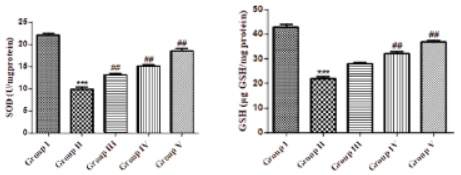
Nephropathy is considered as one of the major secondary complications in diabetic patients. The goal of the current study was to perform preclinical screening of virgin coconut oil (VCO) solubilised curcumin in diabetes-induced nephropathy. Male albino rats of the Wistar strain were injected with a single dose of streptozotocin (STZ) (60 mg/kg/i.p). Diabetic nephropathy (DN) was developed after 4 weeks of STZ injection and the treatment was continued for further 4 weeks (i.e 8 weeks). DN rats were treated with VCO (8ml), VCO solubilised curcumin at a low dose (0.66mg/4ml/kg) and high dose (1.32mh/8ml/kg). DN was assessed by evaluating biochemical parameters such as blood glucose, total protein, albumin, urea, creatinine, and total bilirubin from serum and urine sample, whereas the activity of endogenous antioxidant and membrane- bound phosphatases were studied from kidney homogenate. VCO-solubilised curcumin significantly reduced blood and urine glucose level, increased body weight and reduced kidney weight and kidney hypertrophy. It also normalized urine volume, albumin, creatinine, total protein, total bilirubin and urea levels. Treatment also significantly improved antioxidants and membrane-bound phosphatase activities. In conclusion, compared to the individual treatment group, VCO solubilized curcumin significantly modifies the altered parameters toward normal. The potent antioxidant activity of these substances may be to blame for this defense.

Keywords: Virgin coconut oil, curcumin, diabetes, nephropathy, antioxidants

References

  1. Remuzzi G, Schieppati A, Ruggenenti P. Nephropathy in Patients with Type 2 Diabetes. The New England Journal of Medicine. 2002;346(15):1145–1151. Available from: https://pubmed.ncbi.nlm.nih.gov/11948275/
  2. Ak T, Gülçin İ. Antioxidant and radical scavenging properties of curcumin. Chemico-Biological Interactions. 2008;174(1):27–37. Available from: https://doi.org/10.1016/j.cbi.2008.05.003
  3. Cornejo-Garcia JA, Mayorga C, Torres MJ, Fernandez TD, R-Pena R, Bravo I, et al. Anti-oxidant enzyme activities and expression and oxidative damage in patients with non-immediate reactions to drugs. Clinical and Experimental Immunology. 2006;145(2):287–295. Available from: https://doi.org/10.1111/j.1365-2249.2006.03149.x
  4. Ha H, Lee HB. Oxidative stress in diabetic nephropathy: basic and clinical information. Current Diabetes Reports. 2001;1(3):282–287. Available from: https://doi.org/10.1007/s11892-001-0047-1
  5. Kumar KV, Surendra. Plants as natural antioxidants. Natural Product Radiance. 2006;5(4):326–334. Available from: https://nopr.niscpr.res.in/bitstream/123456789/7962/1/NPR%205%284%29%20326-334.pdf
  6. Lenzen S. The mechanisms of alloxan- and streptozotocin-induced diabetes. Diabetologia. 2008;51(2):216–226. Available from: https://doi.org/10.1007/s00125-007-0886-7
  7. Akh L. Diabetic nephropathy - complications and treatment. International Journal of Nephrology and Renovascular Disease . 2014;7:361–381. Available from: https://doi.org/10.2147/IJNRD.S40172
  8. Nayak SV, Raut PN, Mandhare PN, Gotmare SR. Turmeric: the golden and precious gift of nature. International Journal of Advanced Research. 2017;5(1):1652–1655. Available from: https://doi.org/10.21474/IJAR01/2932
  9. Priyadarsini KI, Maity DK, Naik GH, Kumar MS, Unnikrishnan MK, Satav JG, et al. Role of phenolic O-H and methylene hydrogen on the free radical reactions and antioxidant activity of curcumin. Free Radical Biology and Medicine. 2003;35(5):475–484. Available from: https://doi.org/10.1016/s0891-5849(03)00325-3
  10. Rolo AP, Palmeira CM. Diabetes and mitochondrial function: Role of hyperglycemia and oxidative stress. Toxicology and Applied Pharmacology. 2006;212(2):167–178. Available from: https://doi.org/10.1016/j.taap.2006.01.003
  11. Narayanankutty A, Nair A, Illam SP, Upaganlawar A, Raghavamenon AC. Curcumin Enriched VCO Protects against 7,12-Dimethyl Benz[a] Anthracene-Induced Skin Papilloma in Mice. Nutrition and Cancer. 2021;73(5):809–816. Available from: https://doi.org/10.1080/01635581.2020.1778745
  12. More N, Joshi V, Mahajan M, Upasani C, Upaganlawa A. Neuroprotective Effects of Virgin Coconut Oil Solubilized Curcumin in Diabetic Peripheral Neuropathy. Journal of Pharmacology and Toxicology. 2022;17(1):36–42. Available from: https://scialert.net/abstract/?doi=jpt.2022.36.42
  13. Schena FP, Gesualdo L. Pathogenetic Mechanisms of Diabetic Nephropathy. Journal of the American Society of Nephrology. 2005;16(3_suppl_1):S30–S33. Available from: https://journals.lww.com/jasn/fulltext/2005/03001/pathogenetic_mechanisms_of_diabetic_nephropathy.8.aspx
  14. Stamler JS, Singel DJ, Loscalzo J. Biochemistry of Nitric Oxide and Its Redox-Activated Forms. Science. 1992;258(5090):1898–1902. Available from: https://www.science.org/doi/10.1126/science.1281928
  15. Roden M, Shulman GI. The integrative biology of type 2 diabetes. Nature. 2019;576:51–60. Available from: https://doi.org/10.1038/s41586-019-1797-8
  16. Rohilla A, Tiwari SK, Rohilla S, Kushnoor A. Diabetic nephropathy: pathogenesis, prevention and treatment. European Journal of Experimental Biology. 2011;1(4):72–80. Available from: https://doi.org/10.1016/S0140-6736(98)01346-4
  17. Vasavada N, Agarwal R. Role of oxidative stress in diabetic nephropathy. Advances in Chronic Kidney Disease. 2005;12(2):146–154. Available from: https://doi.org/10.1053/j.ackd.2005.01.001
  18. Prabhakar SS. Role of nitric oxide in diabetic nephropathy. Seminars in Nephrology. 2004;24(4):333–344. Available from: https://doi.org/10.1016/j.semnephrol.2004.04.005
  19. Yuan D, Liu XM, Fang Z, Du LL, Chang J, Lin SH. Protective effect of resveratrol on kidney in rats with diabetic nephropathy and its effect on endoplasmic reticulum stress. European Review for Medical and Pharmacological Sciences. 2018;22(5):1485–1493. Available from: https://www.europeanreview.org/article/14497

Copyright

© 2023 Published by Krupanidhi College of Pharmacy. This is an open-access article under the CC BY-NC-ND license (https://creativecommons.org/licenses/by-nc-nd/4.0/) 

DON'T MISS OUT!

Subscribe now for latest articles and news.