Journal of Pharmaceutical Research
DOI: https://doi.org/10.18579/jopcr/v25.i2.13
Year: 2026, Volume: 25, Issue: 2, Pages: 108-111
Case Report
M Salguna Sambhannan Vivek1*, Kantilal Chainkaran Chandaliya2, Girish Raparti3, Pankaj Digambarrao Patil4, Rushikesh Ramkishan Dhamale1
1Junior Resident, Department of Pharmacology, Dr. Shankarrao Chavan Government Medical College, Nanded, Maharashtra, India
2Professor and HOD, Department of Pharmacology, Dr. Shankarrao Chavan Government Medical College, Nanded, Maharashtra, India
3Associate Professor, Department of Pharmacology, Dr. Shankarrao Chavan Government Medical College, Nanded, Maharashtra, India
4Assistant Professor, Department of Pharmacology, Dr. Shankarrao Chavan Government Medical College, Nanded, Maharashtra, India
*Corresponding Author
Email: [email protected]

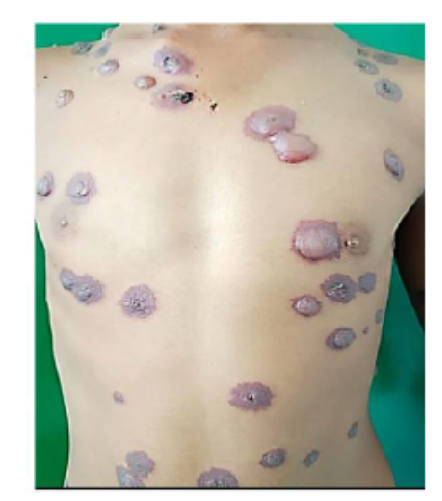
Stevens-Johnson Syndrome is a severe, life-threatening mucocutaneous disease associated with significant morbidity and mortality. Co-amoxiclav (Amoxicillin and Clavulanic acid) is one of the commonly prescribed antimicrobials. Previous incidence recorded with Co-amoxiclav is very rare (1 per million)[1]. A 13-year-old child presented to a local physician with a history of fever and sore throat, for which he was prescribed tablet Co-amoxiclav twice a day. After three days, he initially developed a maculopapular erythematous rash with central blisters first appearing over his four limbs, spread to chest and back and involved a total body area of around 70% on the 5th day. This further progressed to involve oral lesions, bilateral conjunctival congestion, and genital mucosa on Day 6. Patient was admitted for managing the case and a causality assessment was done using the Naranjo Adverse Drug Reaction Probability Scale resulting in a score of "7," indicating the ADR was "probable". The patient was managed with intravenous steroids, antibiotics, intravenous fluids, and other conservative measures. The child recovered and was discharged on 9th day of hospitalization. This ADR was reported to the Indian Pharmacopoeia Commission through the VigiFlow platform as part of India's Pharmacovigilance Program. A validated mathematical tool named "severity-of-illness score for toxic epidermal necrolysis (SCORTEN)" for the prognostication of SJS/TEN patients, predicted the mortality to be around 3.2%. This case highlights the potential for commonly used drugs like Co-amoxiclav to cause severe side effects such as SJS[3]. It underscores the importance of active pharmacovigilance for all medications and vigilant ADR monitoring and management.
Keywords: Co-amoxiclav, Stevens-Johnson Syndrome, Adverse Drug Reactions, Pharmacovigilance
1. Rodríguez-Martín S, Martín-Merino E, Lerma V, Rodríguez-Miguel A, González O, González-Herrada C, <I>et al</I>. Incidence of Stevens-Johnson syndrome/toxic epidermal necrolysis among new users of different individual drugs in a European population: a case-population study. European Journal of Clinical Pharmacology. 2019; 75 (2). Available from: https://doi.org/10.1007/s00228-018-2569-3
2. Ferrandiz-Pulido C, Garcia-Patos V. A review of causes of Stevens–Johnson syndrome and toxic epidermal necrolysis in children. Archives of Disease in Childhood. 2013; 98 (12). Available from: https://doi.org/10.1136/archdischild-2013-303718
3. Fakoya, AOJ, Omenyi P, Anthony P, Anthony F, Etti P, Otohinoyi DA, <I>et al</I>. Stevens - Johnson Syndrome and Toxic Epidermal Necrolysis; Extensive Review of Reports of Drug-Induced Etiologies, and Possible Therapeutic Modalities. Open Access Macedonian Journal of Medical Sciences. 2018; 6 (4). Available from: https://doi.org/10.3889/oamjms.2018.148
4. Tee C T, Abdullah NH, Kristummoonthy P, Lee CS. Severe cutaneous adverse reactions: A 5-year retrospective study at Hospital Melaka, Malaysia, from December 2014 to February 2020. <I>Medical journal of Malaysia</I>. vol. 77,4 (2022): 409-414.
5. Fukasawa T, Urushihara H, Takahashi H, Okura T, Kawakami K. Risk of Stevens-Johnson Syndrome and Toxic Epidermal Necrolysis Associated With Antibiotic Use: A Case-Crossover Study. The Journal of Allergy and Clinical Immunology: In Practice. 2023; 11 (11). Available from: https://doi.org/10.1016/j.jaip.2023.07.012
6. Singalavanija S, Limpongsanurak W. Stevens-Johnson syndrome in Thai children: a 29-year study. <I>Journal of the Medical Association of Thailand = Chotmaihet thangphaet</I>. vol. 94 Suppl 3 (2011): S85-90.
7. Shukla AK, Jhaj R, Misra S, Ahmed SN, Nanda M, Chaudhary D. Agreement between WHO-UMC causality scale and the Naranjo algorithm for causality assessment of adverse drug reactions. Journal of Family Medicine and Primary Care. 2021; 10 (9). Available from: https://doi.org/10.4103/jfmpc.jfmpc_831_21
8. Prakash J, Joshi K, Malik D, Mishra O, Sachan A, Kumar B, <I>et al</I>. “ADR PvPI” Android mobile app: Report adverse drug reaction at any time anywhere in India. Indian Journal of Pharmacology. 2019; 51 (4). Available from: https://doi.org/10.4103/ijp.ijp_595_18
9. Torres-Navarro I, Briz-Redón A, Botella-Estrada R. Accuracy of SCORTEN to predict the prognosis of Stevens‐Johnson syndrome/toxic epidermal necrolysis: a systematic review and meta‐analysis. Journal of the European Academy of Dermatology and Venereology. 2020; 34 (9). Available from: https://doi.org/10.1111/jdv.16137
10. Mulkalwar S, Khan U, Chitale S, Tilak A, Rane B, Patel A. Reimagining the ADR Alert Card: a novel approach to recurrence prevention in low-cost settings for adverse drug reactions. European Journal of Hospital Pharmacy. 2025; 32 (4). Available from: https://doi.org/10.1136/ejhpharm-2024-004131
11. Chan HL, Stern RS, Arndt KA, Langlois J, Jick SS, Jick H, <I>et al</I>. The Incidence of Erythema Multiforme, Stevens-Johnson Syndrome, and Toxic Epidermal Necrolysis. Archives of Dermatology. 1990; 126 (1). Available from: https://doi.org/10.1001/archderm.1990.01670250049006
12. Brayfield A, editor. <I>Martindale: The complete drug reference</I>. 38th ed. London: Pharmaceutical Press; 2014. p. 217.
13. World Health Organization. <I>The use of the WHO-UMC system for standardised case causality assessment</I>. Geneva: WHO; 2018 [cited 2025 Dec 24]. Available from: http://www.who-umc.org/Graphics/24734.pdf
14. Levine GA. <I>Project PEPIDaP. Global estimates of the relative pediatric consumption and cost of oral amoxicillin and amoxicillin-plus-clavulanic-acid</I>. 2015
© 2026 Published by Krupanidhi College of Pharmacy. This is an open-access article under the CC BY-NC-ND license (https://creativecommons.org/licenses/by-nc-nd/4.0/)
Subscribe now for latest articles and news.